

Commercial cattle are the work horse of the beef industry and the heart of our operation. They are where genetic potential meets reality. Commercial herds work on averages and in the margins. They don’t produce headliner animals like purebred operations do. A single animal will never pay the bills. They need to produce consistently good quality, hardy, thrifty cattle. These are herds where females can be retained and steers can be fed. Commercial producers need to buy quality bulls without breaking the bank because, unfortunately, paying more for a bull doesn’t guarantee that he’ll work out. It doesn’t matter how impressive a pedigree is if he can’t walk a full season. That’s actually why we got into purebreds. It allowed us to buy specific genetics we liked and turn them into walking bulls that were longer lasting in our own herd.
A
Commercial Focus
The first time we came across this was in a horse magazine (https://horsemansnews.com/optimal-vs-maximal-growth/) but it really resonated with us. Often, we’d heard purebred bull producers talk about feeding their bulls to their genetic potential but is that accurate? Is lbs/day gain the only measure of genetic potential in breeding stock? We don’t think so. We think the ability to gain is important. We test that in our feeder cattle. We expect our steers to gain 4lbs/day and be slaughter ready by 18 months. We don’t need that in our bulls. We need our bulls to be fertile, quiet, sound, low-maintenance and long-lived. We test our bulls’ ability for optimal gain in their herdmates so we don’t need to see it in them. Bulls that don’t sell in our sale do not go directly to slaughter as they are in breeding condition, not finished condition.
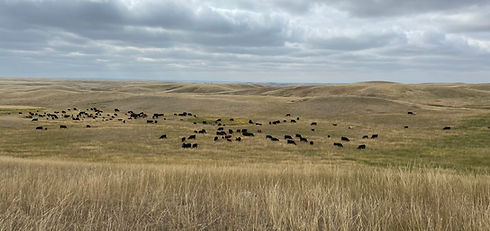
We are proud of our bulls’ abilities to gain on a forage-only ration. Not with a barley pellet, textured feed supplement or any other “nutritionally-balanced” program that you may read about. Forage only. If they can’t grow on that, their genetics don’t belong in commercial herds.
Optimum Growth vs
Maximum Growth

Selecting for disposition is all about safety. No animal is worth putting our family and friends at risk. We are a single family operation and have always had our kids with us when we are working and have relied heavily on the volunteer labour of our friends. Our daughters are astute and capable cattlemen now, but they weren’t always! While there is no such thing as a “safe” environment when working cattle, we try to make it as safe as we can. This starts with the disposition of our cattle. We don’t keep calves that are high strung, flighty or aggressive. And we continue to cull throughout the year. Cows or bulls that become aggressive or unpredictable are shipped. There are a lot of good cattle out there, nobody needs to keep anything dangerous.
Disposition

We moved to this calving season many years ago, when our kids were young. It really lessened the workload at calving time in several ways. Firstly, by eliminating feeding during calving. During the worst of our drought years, we were forced to feed some during calving season and we were reminded of the hassle of it! Secondly, calving problems/malpresentations are pretty rare when cows calve out on pasture. We assume it has a lot to do with the amount of walking and ability to position themselves wherever they’d like. Thirdly, calf vigour is rarely impeded by the weather. If the sun is shining and calves land somewhere warm, there isn’t anything that is stopping them from getting that first drink of colostrum. This means, we aren’t spending extra time warming calves and getting them going.
We realize that spring calving doesn’t work on every operation, but it does on ours and we are extremely grateful! It allows us to enjoy the entire calving season and allows us to develop our young bulls without pushing them.
May-June Calving

Commercial herds need crossbreeding and we feel that Speckle Park can offer a lot of benefit to herds that have become heavily Angus-based. We know that commercial herds are more profitable and healthier than straight-bred herds. The Western Producer had a great article reminding us of this. (https://www.producer.com/livestock/heterosis-an-overlooked-way-to-improve-less-heritable-traits/) We also know that a lot of breeders would prefer to maintain a British herd base and Speckle Park are an ideal outcross. They are a moderate size and have excellent feed efficiency. We have worked to create a herd of Speckle Park cows that are maternal, good-uddered and productive whose offspring will add valuable heterosis to commercial operations.
Why
Speckle Park?

Commercial herds need crossbreeding. The Western Producer had a great article reminding us of this. (https://www.producer.com/livestock/heterosis-an-overlooked-way-to-improve-less-heritable-traits/)
We feel that Simmental can offer a lot of cross-breeding benefit to British based herds. They are the ideal continental breed. They contribute extra muscle and power but still offer strong maternal qualities. Our Simmental bulls are raised in a forage-only system so you need not worry about acquiring high-input seedstock. They are from moderate dams who are structurally sound with quality udders.